Common AC Problems in Port St. Lucie
Find your symptom below to see what commonly causes it, what you can safely observe, and which detailed guide covers it in depth.
Air conditioning complaints are almost always described by symptom, and symptoms are rarely specific to one fault. Warm air can come from a refrigerant leak, a stalled condenser fan, a dirty coil, or an electrical component that lets a motor run below its rated performance. Ice can come from restricted airflow or from low charge. That overlap is why this hub is organized the way a homeowner actually experiences the problem, and why each entry leads to a page that explains how the possibilities are separated.
Long cooling seasons and high humidity shape which of these problems appear most often in Port St. Lucie. Equipment here runs many more hours per year than the same equipment in a cooler climate, condensate volumes are high enough that drainage is a routine concern, and coastal air is hard on outdoor coils and electrical terminals.
AC isn't cooling
The system has power and moves air, but indoor temperature does not fall. Cooling depends on four things working at once — adequate airflow across the indoor coil, a correctly charged sealed system, a compressor that is pumping, and an outdoor coil able to release heat. A fault in any one of them produces the same complaint, which is why the diagnosis relies on measurement rather than appearance.
AC won't turn on
Complete silence points upstream of the refrigeration system: a tripped breaker, an air handler service switch left off, a thermostat without power, a blown low-voltage fuse, a failed transformer, or a condensate safety switch that has opened the cooling circuit. Where the indoor blower runs but the outdoor unit stays quiet, attention shifts to the condenser's starting components instead.
Warm air from the vents
Warm air while the outdoor unit runs suggests the refrigeration circuit is not carrying heat away — reduced charge from a leak, a compressor turning without pumping, or a condenser that cannot reject heat. Warm air with the outdoor unit silent is a different problem, and usually electrical. Noting which of the two you have narrows the possibilities immediately.
Weak airflow
Airflow loss across the whole house implicates the filter, the evaporator coil, the blower, or the return path. Airflow loss in specific rooms implicates the duct runs serving them. The distinction matters because whole-house restriction reduces total capacity and can freeze the coil, while room-specific weakness is a distribution problem the equipment cannot solve.
The AC freezes up
Ice forms when the evaporator coil drops below freezing, which happens with restricted airflow or with refrigerant pressures that are too low. Once frost forms it blocks the airflow that would have thawed it, so a small imbalance escalates quickly. Switching cooling off and running the fan clears the ice; the underlying cause remains until it is diagnosed.
Water around the air handler
A residential system removes a substantial volume of moisture from Florida air every day, and that water is supposed to leave through a drain line. Clogs from biofilm, cracked pans, missing traps, and inadequate slope all send it somewhere else. Meltwater from a frozen coil and condensation on uninsulated refrigerant lines produce similar-looking puddles from different causes.
Outdoor unit not running
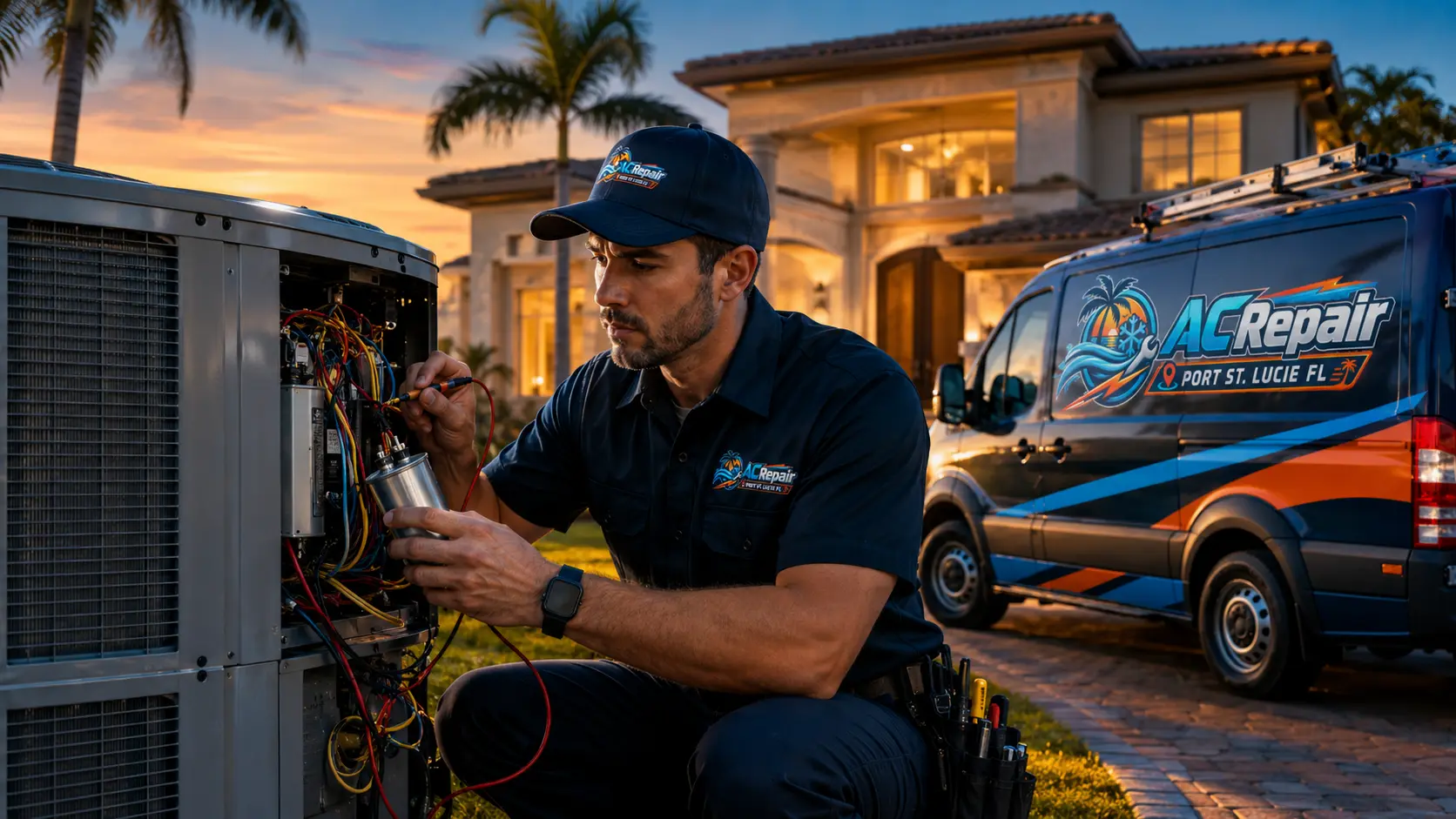
A condenser that hums without starting, clicks repeatedly, or stays silent while the indoor blower runs is usually an electrical story: a run capacitor below its rated value, a contactor not pulling in, a pulled disconnect, or an internal overload protecting the compressor. These are measured in a compartment that stores a charge even with the power off.
Indoor blower not running
If the fan setting produces nothing at the registers, the chain to check runs from thermostat power through the low-voltage circuit to the blower itself. Control fuses, transformers, float switches, and the blower motor or its module are all candidates, and the order of investigation follows the voltage rather than the price of the parts.
Short cycling
Cycles that last only a few minutes suggest something is interrupting operation — a safety device, an electrical fault, a pressure or temperature limit, or airflow restriction driving a protective shutdown. Cycles that end because the thermostat is satisfied too quickly are a different pattern, more often related to placement, configuration, or equipment sizing.
Unusual noises
Sound is genuinely diagnostic. Buzzing and repeated clicking suggest electrical components; screeching and grinding suggest bearings or a blade making contact; a hard metallic knock suggests something mechanical inside the compressor. Describing the noise, its location, and when it occurs during the cycle often narrows the cause before a panel is opened.
High indoor humidity
Air conditioning removes heat and moisture together. A house that sits at its setpoint yet feels clammy has a latent-capacity problem: short cycles, continuous fan operation re-evaporating condensate off the coil, duct leakage drawing humid air from an attic, or equipment oversized for the space. In this climate that complaint deserves the same attention as a temperature complaint.
Thermostat problems
Blank displays, systems that will not shut off, readings that disagree with a separate thermometer, and schedules that reset all point at the control side. Wiring that lacks a common conductor, placement in direct sun, and configuration errors on multi-stage or heat pump equipment are frequent contributors.
Electrical symptoms
Breaker trips, burning smells, scorched wiring, and hum-and-stop behavior all belong to the electrical family of faults. Some are urgent enough to warrant shutting the system off immediately. Because capacitors, contactors, motors, and the compressor share one circuit, the cheapest and most failure-prone components are tested before any conclusion is drawn about the expensive one.
All AC problem guides
AC Repair
How residential cooling systems fail, what a diagnosis examines, and how to request service.
Emergency AC Repair
Which cooling failures are urgent, what to do while you wait, and how to request help.
AC Not Cooling
The system runs, the house stays warm — the possible causes and what a diagnosis examines.
Refrigerant Leak Repair
Where leaks form, how they are located, and what repair versus replacement involves.
Compressor Repair
What the compressor does, what mimics its failure, and how repair compares to replacement.
Fan Motor Repair
Condenser fan and indoor blower problems, and why correct motor selection matters.
Capacitor Replacement
Capacitor failure symptoms, why heat shortens their life, and important safety notes.
Thermostat Problems
When the control side is the problem, and what a thermostat diagnosis examines.
Frozen AC Coil
Why coils freeze in hot weather, what to do first, and what a diagnosis examines.
AC Water Leak
How condensate drainage works, why clogs are common here, and what a diagnosis examines.
Wondering what a repair involves financially? The AC repair cost guide explains the factors behind a quote, and the service areas page covers the neighborhoods this site focuses on.
Not sure which problem you have?
Call 772-946-1295 to describe what your system is doing, or send a service request and we will follow up to arrange a visit.