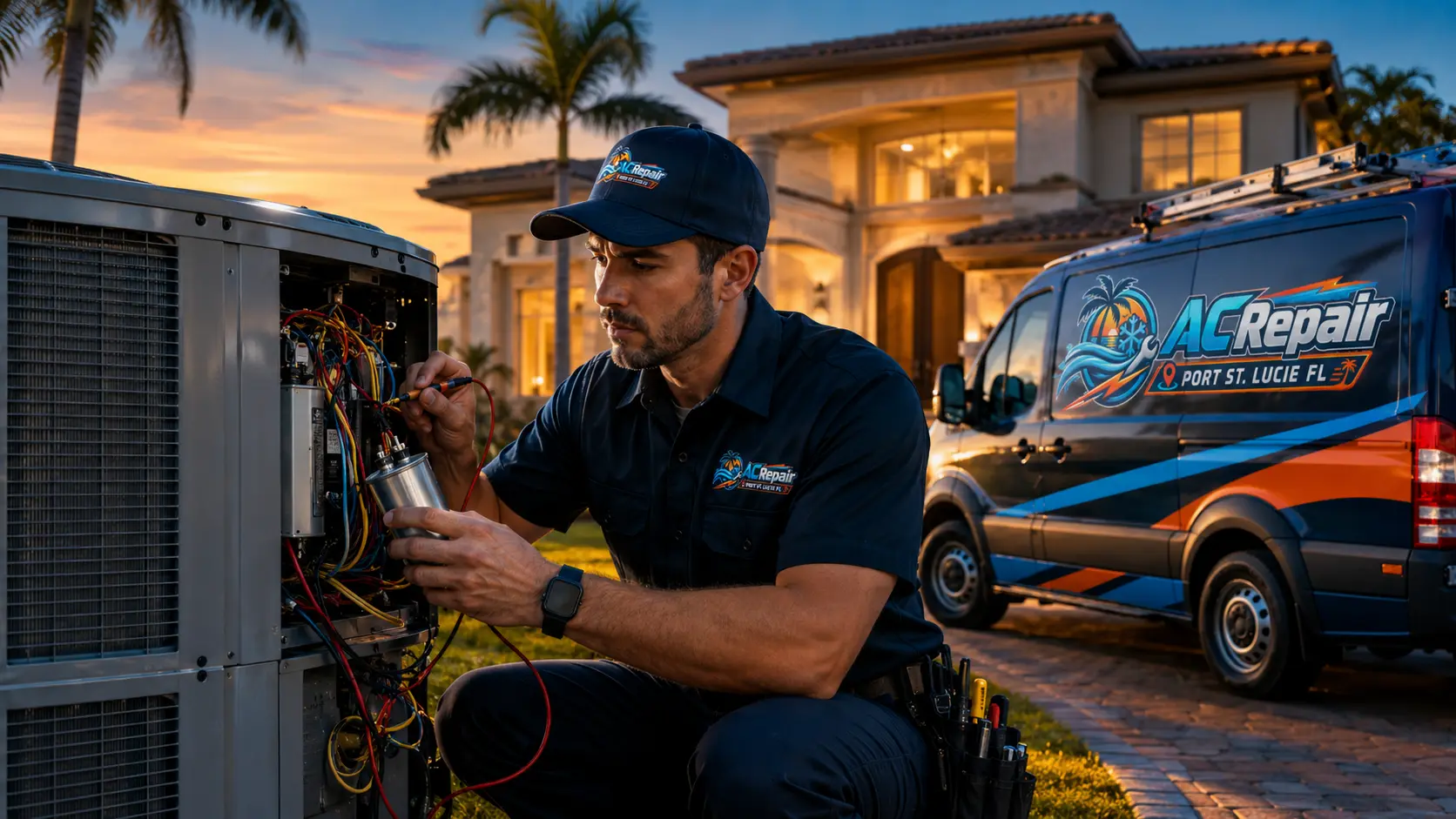
A capacitor is a small cylindrical component in the electrical compartment of an air conditioner that stores and releases energy to help motors start and keep running. It is inexpensive relative to the rest of the system, and it is also one of the components most affected by sustained heat.
Single-phase motors of the type used in residential air conditioning need help creating the rotating magnetic field that gets them turning. Capacitors provide that help. A start capacitor delivers a brief high-energy pulse; a run capacitor stays in the circuit continuously to improve efficiency and torque. Many residential condensers use a dual run capacitor serving both the compressor and the outdoor fan.
Capacitors degrade gradually. Their capacitance, measured in microfarads, drifts away from the rated value long before they fail outright, which produces intermittent symptoms that come and go with outdoor temperature.
Symptoms associated with a failing capacitor
Because a weakening capacitor affects starting more than running, its symptoms often appear at the beginning of a cycle and then disappear once the motor is turning.
Patterns commonly reported
•A hum or buzz from the outdoor unit with no motor rotation
•The unit tries to start, clicks off, and tries again a few minutes later
•The condenser fan turns slowly or hesitates before reaching speed
•Cooling works in the morning and fails during the hottest part of the day
•The system trips its breaker intermittently on start-up
•A visibly swollen top on a capacitor or oily residue in the compartment
Why heat is so hard on capacitors
Capacitor life is strongly temperature dependent. The electrolyte and dielectric materials inside break down faster as internal temperature rises, and a condenser sitting in direct Florida sun through a long cooling season subjects its electrical compartment to exactly that condition for months at a time.
Anything that raises operating temperature — a dirty condenser coil, restricted clearance around the unit, a struggling fan motor — shortens capacitor life further. That is why a capacitor that fails repeatedly is treated as a symptom of an underlying condition rather than as a part that simply needs replacing again.
Serious safety notes
Capacitors are the reason the electrical compartment of an air conditioner is not a homeowner-serviceable area. They can retain a stored electrical charge after the disconnect is pulled and the breaker is off, and that stored energy is capable of causing serious injury.
Discharging, testing, and replacing a capacitor is straightforward for a technician with the right meter and procedure, and genuinely hazardous without them. Verifying the capacitor before assuming a motor or compressor has failed is one of the highest-value steps in AC diagnosis precisely because it is quick for someone equipped to do it safely.
How capacitors are tested and matched
A technician isolates and safely discharges the component, then measures actual capacitance against the value printed on its label. Manufacturers publish a tolerance band, and a reading outside that band indicates replacement even if the motor is currently running.
Replacement matching involves both microfarad rating and voltage rating. An undersized microfarad value leaves the motor under-torqued and running hot; a voltage rating below the application is unsafe. Physical size and terminal configuration also have to suit the cabinet.
What else gets checked during the same visit
Because the capacitor shares its compartment with the contactor and the main wiring, those are typically inspected at the same time. Pitted contactor points, discolored terminals, and heat-damaged insulation all indicate an electrical environment that will keep consuming components.
Motor current draw is also worth measuring after replacement, since a motor drawing above its rated amperage will shorten the life of the new capacitor just as it did the old one.
Where capacitor failure fits among other AC problems
Capacitor symptoms overlap heavily with compressor and fan motor symptoms, and a system that will not start can involve any of the three. Ruling out the least expensive and most failure-prone component first is standard practice, and it is the main reason a no-start condition should never be quoted as a major repair without electrical testing.
What you can safely check yourself
✓Note whether the hum is continuous or cuts out after a few seconds
✓Note whether symptoms correlate with the hottest part of the day
✓Listen for a repeated click every few minutes at the outdoor unit
✓Check the breaker position without repeatedly resetting it
✓Note the age of the equipment from the data plate
Leave these to a qualified technician
✕Removing the electrical access panel on the condenser under any circumstances
✕Touching capacitor terminals, even with the power off
✕Buying and installing a replacement capacitor based on physical appearance
It is strongly discouraged. Capacitors store a charge after power is disconnected, and an incorrectly rated replacement can damage the motor it serves. This is a case where the risk is disproportionate to the cost of the repair.
Why did my capacitor fail again after being replaced?
Repeat failures usually point to an underlying condition — high operating temperature, a dirty condenser coil, a motor drawing excessive current, or voltage supply problems. The replacement addresses the symptom; the condition needs to be identified too.
Can a capacitor be partly failed?
Yes, and that is common. Capacitance drifts below rated value gradually, producing intermittent starting problems that worsen as ambient temperature rises before the component fails completely.
Does a bad capacitor damage anything else?
It can. A motor asked to start and run with insufficient capacitance draws higher current and runs hotter, which shortens its life. That is part of why the symptom is not worth ignoring.
How is a dual capacitor different from a single one?
A dual run capacitor combines two capacitance values in one housing, typically serving the compressor and the condenser fan. One side can fail while the other still works, which explains a fan that runs while the compressor will not start, or the reverse.
Need help with capacitor replacement in Port St. Lucie?
Call 772-946-1295 to describe what your system is doing, or send a service request and we will follow up to arrange a visit.