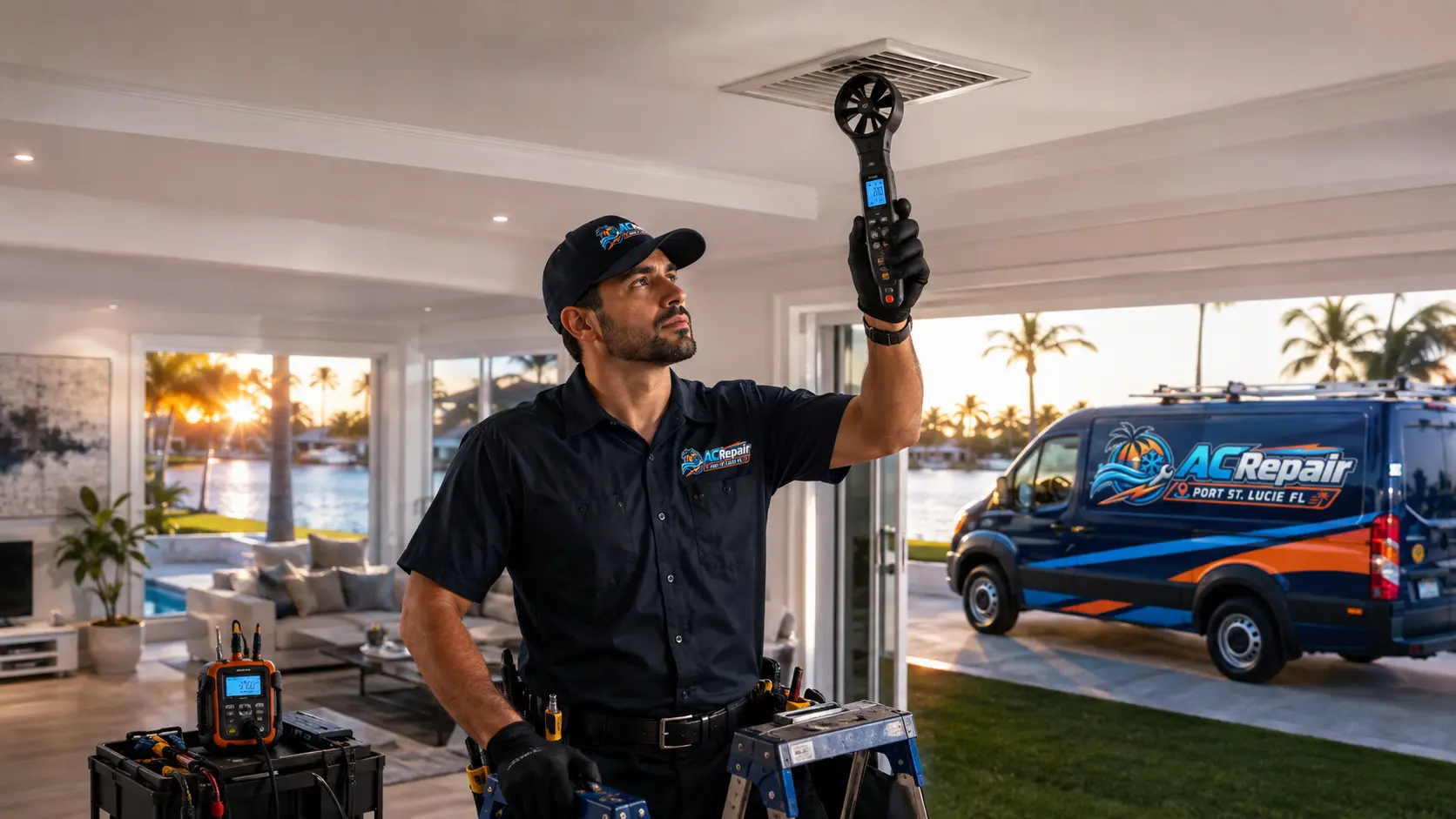
An air conditioner that runs continuously without lowering indoor temperature is one of the most common cooling complaints in Port St. Lucie. The system still has power and still moves air, which means the fault lies somewhere in its ability to actually move heat out of the house.
Cooling is a heat-transfer process, not an air-blowing process. Warm indoor air passes over a cold evaporator coil, gives up heat and moisture to the refrigerant, and the refrigerant carries that heat outside where the condenser releases it. Four things must work simultaneously: enough air across the indoor coil, a correctly charged sealed system, a functioning compressor, and effective heat rejection outdoors.
When the system runs but comfort never arrives, one of those four is compromised. The useful diagnostic question is which one, and the answer is rarely obvious from inside the house.
Airflow problems: the most frequently overlooked cause
If too little air crosses the evaporator coil, the coil cannot absorb heat at its designed rate. Vents may feel cold to the hand while the house never cools, because a small volume of very cold air removes less total heat than a large volume of moderately cooled air.
Restricted filters, dirty evaporator coils, closed or blocked supply registers, crushed flex duct, undersized returns, and weakening blower motors all reduce airflow. Severe restriction can eventually drop coil temperature below freezing and cause ice, which then blocks airflow further.
Refrigerant charge and sealed-system faults
Refrigerant circulates in a closed loop and is not consumed, so a system that is low is a system that is leaking. Reduced charge lowers system capacity progressively, which is why this failure mode often presents as cooling that has degraded over weeks or months rather than stopping suddenly.
Restrictions inside the circuit produce similar complaints. A metering device that is not feeding the coil correctly, or contamination in the lines, can leave a properly charged system unable to cool. Distinguishing between these requires pressure and temperature measurements taken while the system runs.
Heat rejection at the outdoor unit
The condenser has to dump absorbed heat into outdoor air that may already be above ninety degrees. Coil fins packed with grass clippings, dryer lint, salt residue, or landscaping debris reduce that ability, as does a fan that spins slowly or not at all.
Clearance matters too. Shrubs grown tight against a condenser, a fence panel installed close to the discharge, or a unit tucked into an unventilated alcove can force it to recirculate its own hot exhaust air.
Electrical faults that leave a system half-running
A weak run capacitor can allow a motor to turn while operating below its rated performance, producing partial cooling rather than none. Pitted contactors, loose lugs, and voltage imbalance can cause similar underperformance.
These faults are measurable rather than visible, which is why a technician tests capacitance and current draw instead of relying on whether a component appears to be running.
When the problem is humidity rather than temperature
In Port St. Lucie, a home can sit at its setpoint and still feel warm because indoor relative humidity is high. Oversized equipment that satisfies the thermostat in short bursts removes less moisture than correctly sized equipment running longer cycles.
Duct leakage in a hot attic, unsealed return-side leaks pulling in humid air, and ventilation issues all contribute. If your complaint is clamminess rather than temperature, that distinction is worth mentioning when you request service.
Related problems worth ruling out
Ice on the line set points toward airflow or charge issues and is covered in more depth on the frozen coil page. Water near the air handler suggests condensate drainage trouble. A silent outdoor unit changes the diagnosis entirely and usually indicates an electrical or control fault rather than a capacity problem.
What you can safely check yourself
✓Measure the temperature at a supply vent and at the return grille and note the difference
✓Check the filter and note the date it was last replaced
✓Confirm all supply registers are open and unobstructed by furniture or rugs
✓Look at the outdoor coil for visible dirt, debris, or crushed fins
✓Confirm the outdoor fan is spinning at a steady speed
✓Check whether the large insulated copper line is cold and sweating or warm and dry
Leave these to a qualified technician
✕Adding refrigerant from a retail can
✕Removing the top fan grille of the condenser to clean the coil interior
Why does the air feel cold at the vent if the house is not cooling?
Cold air at low volume removes little total heat. Restricted airflow produces exactly that pattern, which is why a hand test at a vent can be misleading without an airflow measurement.
Can a dirty filter really stop a house from cooling?
A severely restricted filter can reduce capacity substantially and, in some cases, lead to coil icing. It is not always the cause, but it is inexpensive to eliminate as a variable.
How much of a temperature drop should a system produce?
Many residential systems produce a return-to-supply difference in the high teens to low twenties in degrees Fahrenheit, though humidity and equipment design shift the expected range. A technician interprets it alongside pressure readings rather than in isolation.
Could the thermostat be the reason nothing cools?
A thermostat reading a false temperature, placed in direct sun, or configured incorrectly for a heat pump can produce odd comfort complaints. It is worth checking, though it more often causes cycling problems than a total loss of capacity.
The system cools at night but not in the afternoon. Why?
Marginal capacity shows up first at peak load. A system that keeps up at eighty degrees outdoors and falls behind at ninety-five is often low on charge, dirty on one of its coils, or short on airflow.
Need help with ac not cooling in Port St. Lucie?
Call 772-946-1295 to describe what your system is doing, or send a service request and we will follow up to arrange a visit.