What actually counts as an AC emergency?
Anything with a safety dimension — burning smells, smoke, repeated breaker trips, or active water damage — plus a complete loss of cooling in extreme heat when vulnerable people are in the home.
Not every cooling problem is an emergency, but some are. This page explains which air conditioning failures warrant an urgent call, which ones can safely wait for a scheduled visit, and how to keep a Port St. Lucie home tolerable in the meantime.
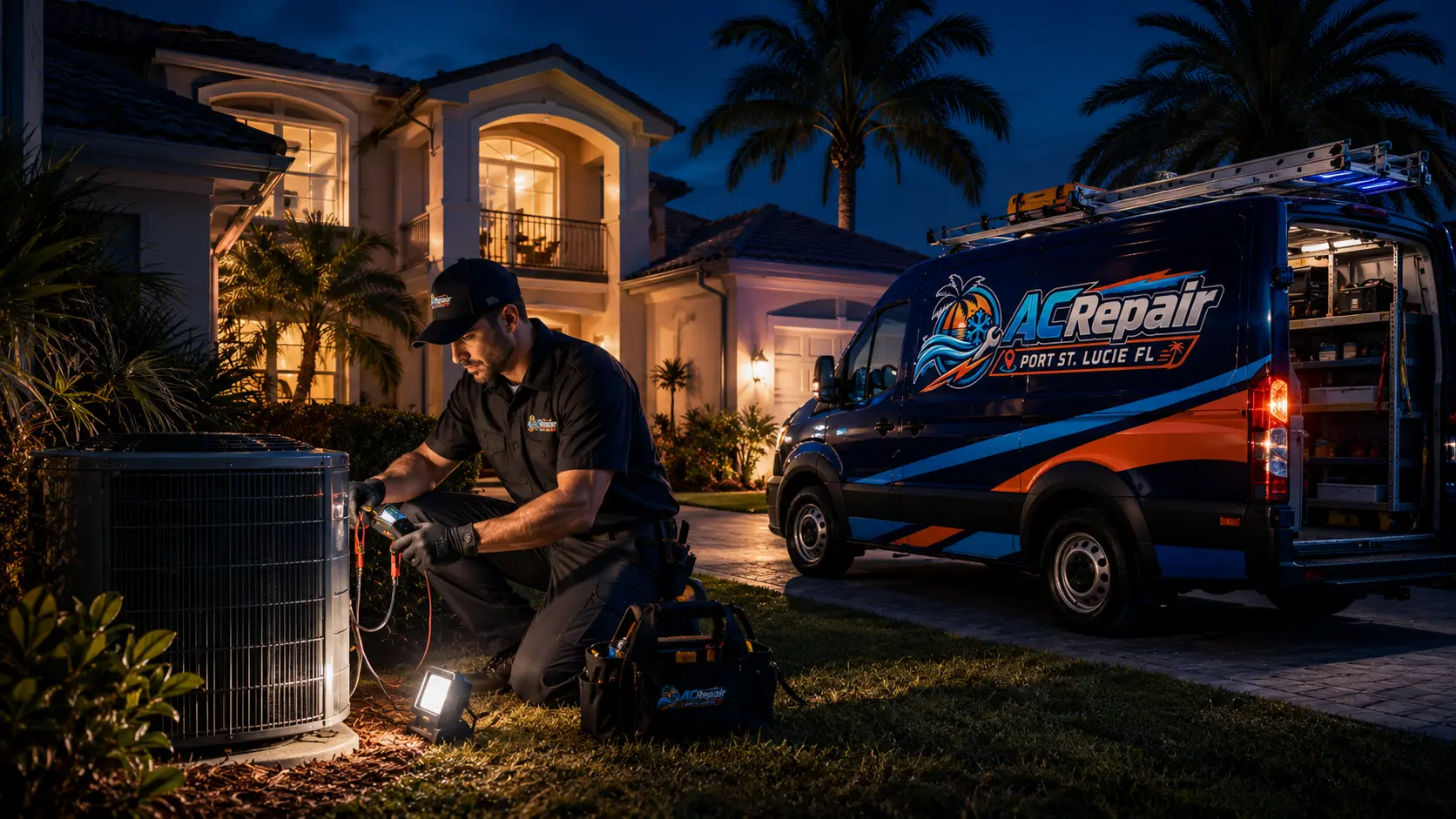
In a climate where indoor temperatures can climb well past comfortable within hours of a system failure, urgency is partly about the equipment and partly about the household. A total loss of cooling matters more when infants, older adults, people with medical conditions, or pets are in the home.
There is also an equipment-safety dimension. A handful of failure modes cause additional damage every minute the system keeps running, so the correct first action is often to shut the system off rather than to keep trying it.
Certain symptoms are signals to stop operating the equipment immediately and then call. Continuing to run through them risks compressor damage, water damage, or an electrical hazard.
Other failures are uncomfortable and worth prompt attention without being hazardous. Complete loss of cooling during a heat advisory, an outdoor unit that will not start, or a system that runs continuously without lowering indoor temperature all fall into this group.
Weak cooling that has developed gradually over weeks usually does not need an after-hours response, though it does deserve diagnosis before it becomes a total failure during the hottest part of the season.
A meaningful share of no-cooling calls trace back to something a homeowner can verify in two minutes. Confirming these first does not fix a real fault, but it makes the call more useful and occasionally restores cooling outright.
Close blinds and curtains on sun-facing windows, run ceiling fans in occupied rooms, and avoid using the oven or dryer during the hottest hours. Ceiling fans cool people rather than rooms, so leaving them running in empty rooms provides no benefit.
Hydration matters more than most people expect in Florida humidity, and a home without cooling can stay warm well into the evening because building materials release stored heat slowly. If indoor temperatures become genuinely unsafe for someone in the household, relocating temporarily is the sensible choice.
An urgent visit follows the same logic as a scheduled one but prioritizes restoring safe operation. A technician generally verifies power and control voltage, checks safeties that may have shut the system down, measures the capacitor and contactor, and confirms whether the compressor and fan motors will start and draw normal current.
If the failed component is a common stocked part, cooling may be restored the same visit. If a coil, compressor, or specialty board is involved, the realistic outcome is a diagnosis, a written repair plan, and guidance on keeping the home livable until parts arrive.
Florida's storm season introduces failure modes that are rare elsewhere. Lightning-induced surges damage control boards and compressor windings, and repeated brownouts can be harder on motors than a clean outage. After a significant outage it is generally better to let the system rest several minutes before restarting rather than cycling it repeatedly.
Flooding around an outdoor unit is also worth reporting when you call, because submerged electrical components require inspection before the equipment is energized.
The system runs, the house stays warm — the possible causes and what a diagnosis examines.
Capacitor failure symptoms, why heat shortens their life, and important safety notes.
How residential cooling systems fail, what a diagnosis examines, and how to request service.
Not sure which of these matches your system? Start with the AC problems overview or read how repair pricing is put together on the AC repair cost page. You can also see the Port St. Lucie areas covered.
Anything with a safety dimension — burning smells, smoke, repeated breaker trips, or active water damage — plus a complete loss of cooling in extreme heat when vulnerable people are in the home.
Surge damage to a control board, a tripped breaker or surge device, or a damaged contactor are all possibilities. Report the storm when you call, since it narrows the likely causes considerably.
It is not hazardous, but it does mean no heat is being removed from the home. Indoor temperature will climb steadily, so it is usually treated as urgent during hot weather.
No. Residential systems have one cooling capacity, so a lower setpoint does not increase output. It only extends runtime, which can worsen a freeze-up if airflow or refrigerant is already compromised.
A portable or window unit can make one room tolerable, which is often enough to get a household through a night. It is a comfort measure, not a repair.
Call 772-946-1295 to describe what your system is doing, or send a service request and we will follow up to arrange a visit.