
How long does a frozen coil take to thaw?
From a couple of hours to most of a day depending on how much ice accumulated. Running the blower with cooling off shortens it substantially.
Ice on an air conditioner during a Florida summer looks contradictory, but it follows directly from how the refrigeration cycle works. When the evaporator coil drops below freezing, the moisture it pulls from indoor air turns to frost instead of draining away — and the frost makes the underlying problem worse.
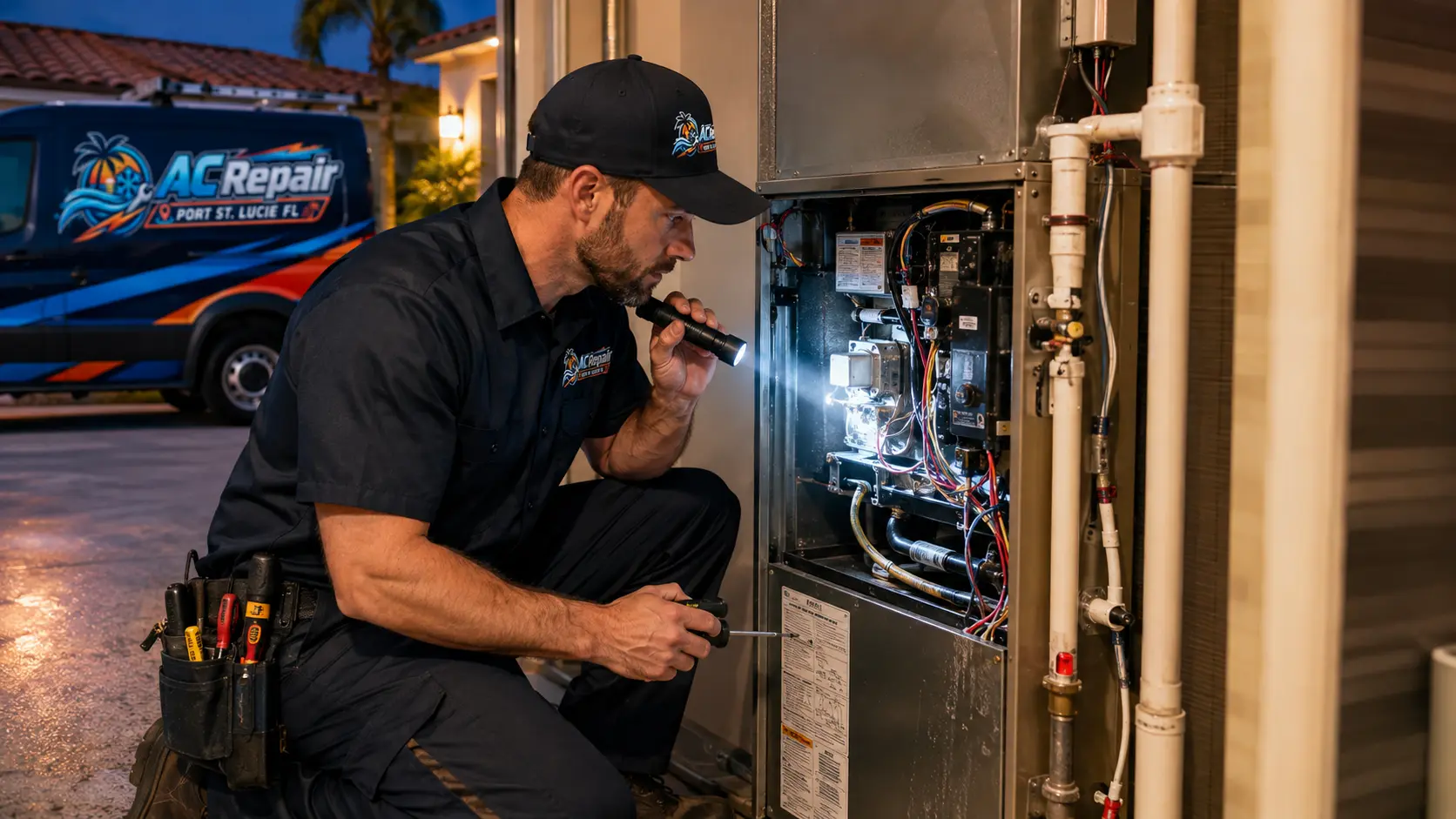
The evaporator coil is designed to run cold but above freezing, so condensed moisture runs off into the drain pan. Two conditions push it below that threshold: not enough warm air passing across it, or refrigerant pressure that is too low to keep the coil temperature where it belongs.
Once ice forms, it insulates the coil and blocks the airflow that would have thawed it, so a small imbalance escalates into a fully frozen system. That feedback loop is why the first action is to stop the cooling cycle rather than to keep running it.
Switch the thermostat from cool to off, then set the fan to on if the equipment allows it. Circulating room-temperature air across the coil speeds thawing considerably compared with leaving everything off.
Restricted airflow is the most common origin. A blocked filter, an evaporator coil matted with dust, a blower wheel loaded with debris, collapsed or disconnected flex duct, undersized return ducting, and closed registers all reduce the volume of warm air reaching the coil.
Air-side restriction has a distinctive signature: it usually develops over time, often follows a missed filter change, and frequently comes with weak airflow complaints that predate the ice by weeks.
A system low on refrigerant operates at reduced suction pressure, and lower pressure means a lower coil temperature. A leak is the reason a system is low, so freezing tied to charge loss usually accompanies a gradual decline in cooling performance.
Restrictions inside the sealed circuit produce similar effects locally. A metering device that is not feeding the coil evenly can freeze one section while another stays clear, which is a pattern a technician looks for during inspection.
Running an air conditioner when outdoor temperatures are relatively low reduces system pressures and can cause icing even on a healthy system, which is more relevant during Florida's cooler months than mid-summer. A failing blower motor, a dirty coil surface, and a stuck contactor keeping the compressor running continuously can all contribute.
Repeated freeze-and-thaw cycles are worth taking seriously beyond the comfort issue: melting ice can overwhelm the drain pan, and liquid refrigerant returning to the compressor is a recognized cause of mechanical damage.
Accurate measurement requires a thawed, dry coil, which is why a technician arriving at a frozen system may need to thaw it before meaningful testing can begin. Once clear, the evaluation typically covers filter and coil condition, blower operation and speed configuration, static pressure across the air handler, and duct condition.
Refrigeration measurements follow: operating pressures, superheat and subcooling, and inspection for evidence of leakage. Establishing airflow first matters, because refrigeration readings taken on an air-starved system can be misleading.
Ice is a symptom. Thawing the coil restores cooling temporarily, but the imbalance that caused it remains, and the system will usually freeze again. Addressing the underlying cause — restoring airflow, repairing a leak, or correcting a mechanical fault — is what prevents recurrence.
Routine filter changes and keeping supply and return paths clear are the two homeowner actions with the largest effect on the airflow side of the equation.
The system runs, the house stays warm — the possible causes and what a diagnosis examines.
Where leaks form, how they are located, and what repair versus replacement involves.
How condensate drainage works, why clogs are common here, and what a diagnosis examines.
Not sure which of these matches your system? Start with the AC problems overview or read how repair pricing is put together on the AC repair cost page. You can also see the Port St. Lucie areas covered.
From a couple of hours to most of a day depending on how much ice accumulated. Running the blower with cooling off shortens it substantially.
It may cool for a while, but the condition that caused the freeze is still present. Without correcting airflow or the refrigeration fault, recurrence is likely.
Frost travelling along the suction line generally indicates the coil upstream is already frozen and the refrigerant is returning colder than it should. It is the same problem seen from a different point in the circuit.
It can. Melting ice can overflow the drain pan, and liquid refrigerant returning to a compressor designed for vapour is a known contributor to mechanical failure.
High humidity means the coil condenses more moisture, so there is more water available to freeze once the coil drops below freezing. Humidity does not cause the imbalance, but it makes the result more dramatic.
Call 772-946-1295 to describe what your system is doing, or send a service request and we will follow up to arrange a visit.