
Can old ductwork be improved without replacing everything?
Often yes. Sealing accessible leaks, correcting crushed or sagging runs, and adding return capacity can improve delivered airflow substantially without a full replacement.
Port St. Lucie, FL
Prima Vista Boulevard runs through the northeastern section of Port St. Lucie, one of the earliest developed parts of the city, with established residential streets and mature landscaping throughout.
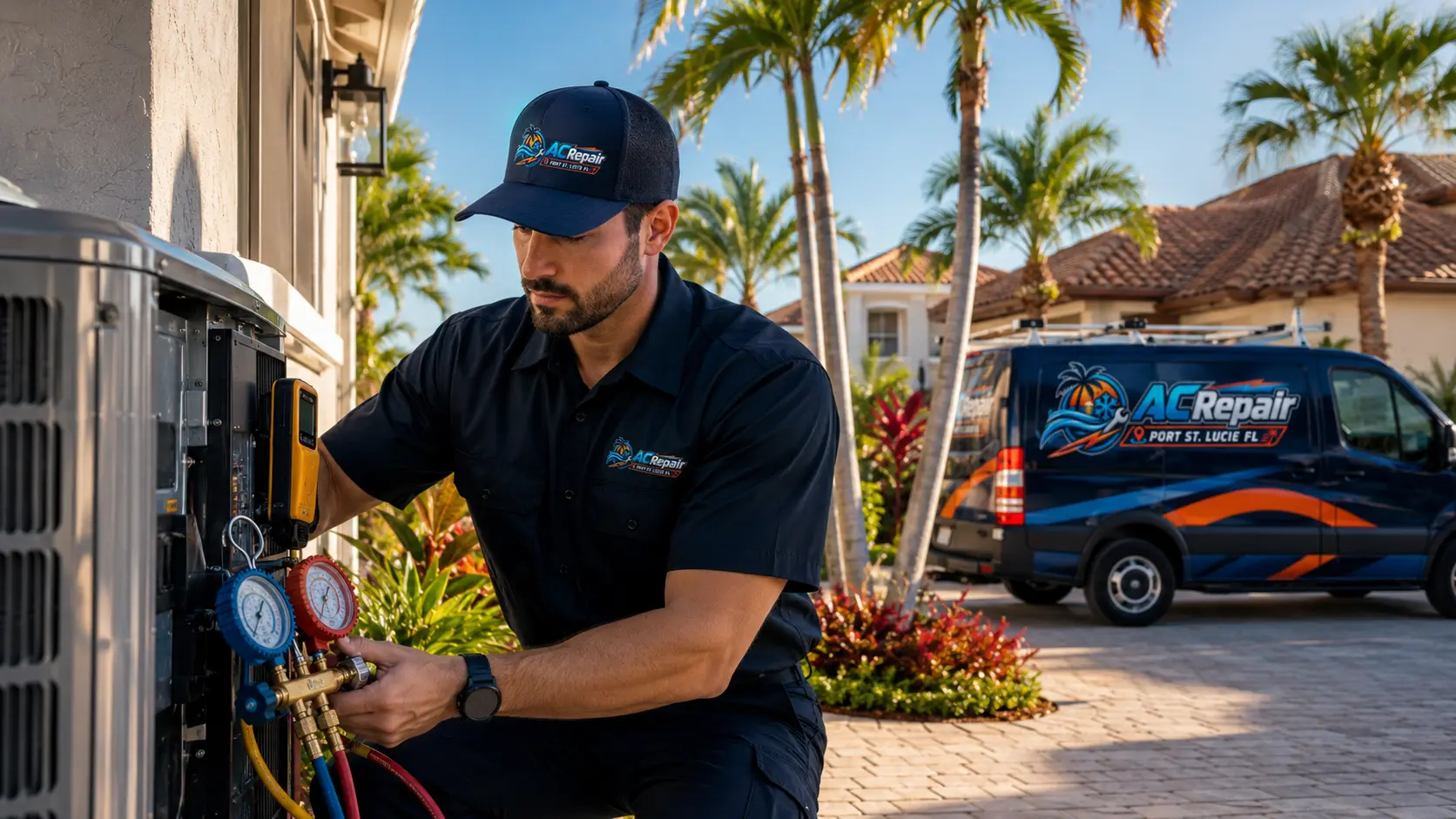
Older neighborhoods bring a distinct set of cooling considerations. Homes here have generally been through several generations of air conditioning equipment, and the distribution systems inside them may be considerably older than the units they serve.
Mature tree cover shades many properties, which reduces heat gain on the building — a genuine advantage — while also depositing leaves and organic debris into outdoor units and growing into the clearance those units need.
A common configuration in this part of the city is modern equipment installed on an older duct system. The result can be disappointing performance from a unit that is functioning correctly, because delivered airflow at the registers is governed by the ductwork rather than by the equipment's rating.
Return-side capacity is frequently the limiting factor in older homes, where a single small return may serve an entire house. That restricts the blower, raises static pressure, and reduces both capacity and equipment life.
Shade over a condenser is helpful when it comes with adequate clearance and unobstructed discharge. It becomes a problem when hedges close in around the cabinet, when leaf litter accumulates against the base, or when organic debris mats into the fin pack.
Root systems and shifting soil can also settle equipment pads over time, and a condenser that is no longer level affects oil return inside the compressor as well as drainage around the base.
Issues in the Prima Vista area often relate to the age of both the homes and the infrastructure.
For older properties, knowing whether the ductwork has ever been replaced or modified is a genuinely useful detail, because it shapes how a performance complaint is investigated.
The system runs, the house stays warm — the possible causes and what a diagnosis examines.
How condensate drainage works, why clogs are common here, and what a diagnosis examines.
Condenser fan and indoor blower problems, and why correct motor selection matters.
See every neighborhood on the service areas page, or read the general AC repair overview.
Often yes. Sealing accessible leaks, correcting crushed or sagging runs, and adding return capacity can improve delivered airflow substantially without a full replacement.
Shade reduces solar heat gain on the cabinet, which helps, as long as clearance around and above the unit is maintained and debris is not accumulating in the coil.
Airflow and static pressure measurements, room-by-room supply temperatures, and inspection of accessible duct runs distinguish between them. Symptoms alone rarely do.
Call 772-946-1295 to describe what your system is doing, or send a service request and we will follow up to arrange a visit.